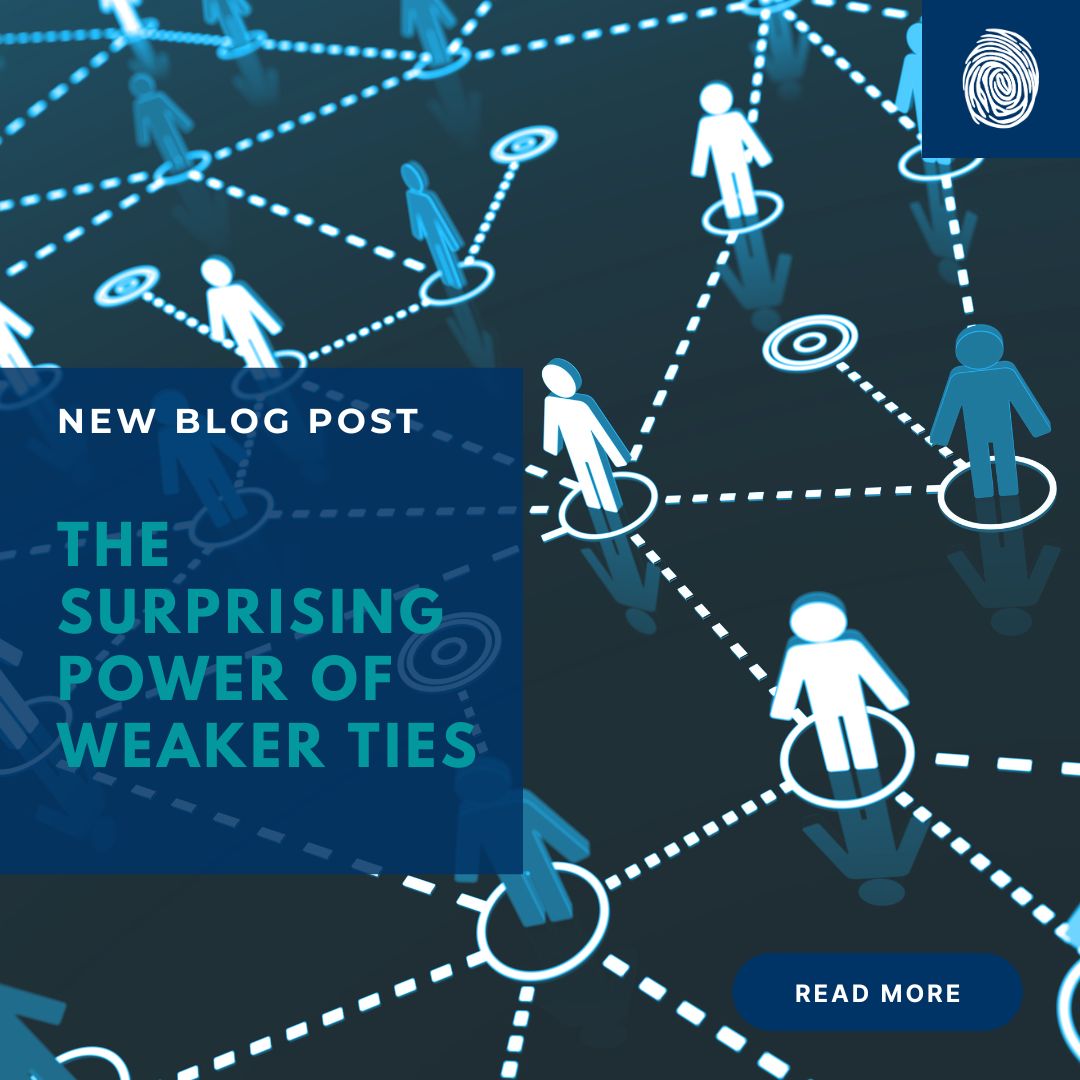
Stanford sociologist Mark Granovetter coined the theory of “The Strength of Weak Ties”, and recent research continues to back it up. His findings suggest that our looser connections, those acquaintances, colleagues we know a little, or even people we’ve only met online are actually more likely to open doors to new opportunities than our inner circle.
Why?
Because our close friends and colleagues tend to know what we know. We share similar networks, ideas, and resources. But weaker ties? They connect us to different people, new information, and fresh perspectives. They’re often the ones who’ll say your name in rooms you’re not in.
In a 2022 study published by researchers at MIT and Stanford, it was shown that job mobility and career growth were more likely to be influenced by weak connections than strong ones. It turns out, those “fringe” relationships we sometimes undervalue may just be the golden threads in our web of growth.
Ever felt like you’ve been dropped like a ton of hot bricks?
One day you’re in the group chat, sharing memes and voice notes, and the next… well, you’re watching from the sidelines as new besties emerge, brunch plans are made without you, and you wonder what on earth just happened.
Let’s call it what it is: the adult version of being ditched at the schoolyard gates.
It can feel like rejection. Like invisibility. Like your presence was only ever useful, until someone shinier came along. And when it happens inside professional circles or close-knit communities, the sting hits twice as hard. Because not only are friendships shifting, but so are your networks, opportunities, and sense of belonging.
And it’s not just emotional, it’s neurological.
Neuroscientist David Rock’s SCARF model tells us that Relatedness, our sense of social connection and belonging—is one of the five core social drivers that shape how we feel and perform at work. When relatedness is threatened, our brain reacts as if we’re under physical threat. That explains why being excluded or replaced, even unintentionally, can feel so sharp. It’s our brain’s way of saying: You might not be safe here.
The In Crowd, the Out Crowd, and the messy middle
Humans are wired for connection, but we’re also wired for survival and sometimes that means gravitating toward the people who offer us momentum, influence, or visibility. That’s not always malicious. It’s just messy.
You’ve probably seen this play out at conferences, retreats, or group programs: fast bonds form over shared values or vibes, and new “circles” emerge sometimes without conscious exclusion, but the impact feels the same.
As someone who hosted an event for 140+ coaches in America, I felt this in a very particular way.
Yes, I got to witness friendships blossom and communities deepen. I watched business collaborations spark over coffee and mentors step in at just the right moment. As the host, though, I didn’t get to have as many deep conversations as I would have liked. I found myself wanting to sit longer with some of the people I admire. And while it was heartening to see others connect so quickly, there were moments where I had to remind myself, creating the space for others to find their people is part of the privilege of holding the room. Leaders often play this role and feel this messy middle.
That’s real. That’s human. And it’s okay to name it. There are more days in the year.
So, What Do We Do With This?
We keep showing up.
We celebrate new connections forming around us, even if they weren’t with us. We tend to our closest friendships and let them deepen, and we give ourselves permission to feel the ache of being left out without making it mean we’re unworthy or forgettable.
We also keep investing in the broader community and teams, those we know loosely, those we’re curious about, and those who might be on the outer edges of someone else’s circle too.
Because the magic often lives there.
And in our increasingly hybrid world, even something as simple as turning your camera on during a Zoom or Teams meeting can make all the difference. So much of connection is non-verbal, facial expressions, eye contact, body language. When we stay hidden, we miss the chance to build the weaker ties that often become the most impactful.
Some of the most impactful collaboration and innovation happens when we step outside our immediate team or department. Whether it’s connecting with a colleague in a different function, reaching out to someone from another business unit, or saying yes to an industry event you’d usually skip, these are the moments where weak ties can unlock new thinking.
Your CliftonStrengths can help here
If you lead with Relator, consider deepening a weak connection one conversation at a time.
If you bring Woo, Includer or Communication, use that to make first contact easier for others.
Connectedness, Individualization, or Empathy might help you spot who’s feeling left out and bring them in.
Learner, Futuristic, or Ideation? Use curiosity to guide your outreach and spark possibility.
These are not just networking strategies they’re strengths-based ways to build culture, community, and innovation beyond silos.
A Few Questions to Reflect On:
-
Which of your talents help you naturally make new connections? What could it look like if you used it 1% more?
-
What kinds of people do you seek out, and why?
-
Are there any missed opportunities in your network where a weak tie could become a strong ally?
-
How do you stay open to serendipitous connections, rather than defaulting to the familiar?
Some of you may say you have already found your people, those trusted connections you can bounce ideas off, celebrate wins with, and lean on when things get tough.
But don’t forget the quiet power of reaching out to someone new—whether it’s a wave across the Zoom screen, a message in Circle, or a simple
“Hey, I’d love to connect sometime.”
Take the first step now.
You never know what ideas, collaborations, or friendships are just waiting on the other side of a conversation.
And every strong tie starts as a weak one just waiting for the chance to deepen.
We build communities like this not to stay in our comfort zone, but to stretch it.
Who might you reach out to today that changes how you think tomorrow?